
Training / Resort Pro plan / Lesson 2 of 12
The ledger: real accounts
Every booking, invoice, payment, refund, purchase and expense is written into a proper set of accounts by itself. The accountant gets a trial balance, a profit and loss statement and a balance sheet without anyone typing entries.
- Modules
- M29 Double-entry ledger and bank reconciliation
- Who uses it
- Accountant, owner, the resort's CA
- Plan
- Resort Pro plan
- Where
- Money › Ledger
What it is for
On Stay and Resort, the Books screen is a cash book: money in, money out. That is not enough for a business that owes suppliers, is owed money by companies, holds guests' advances, and must show a balance sheet to a bank or a tax officer.
Double-entry is how accountants have kept books for centuries: every transaction is written in two accounts at once, so the books always balance and mistakes show up. A ledger is the full set of those accounts. A journal is one entry. The chart of accounts is the list of accounts the business uses. The financial year in India runs from 1 April to 31 March.
What the accountant sees
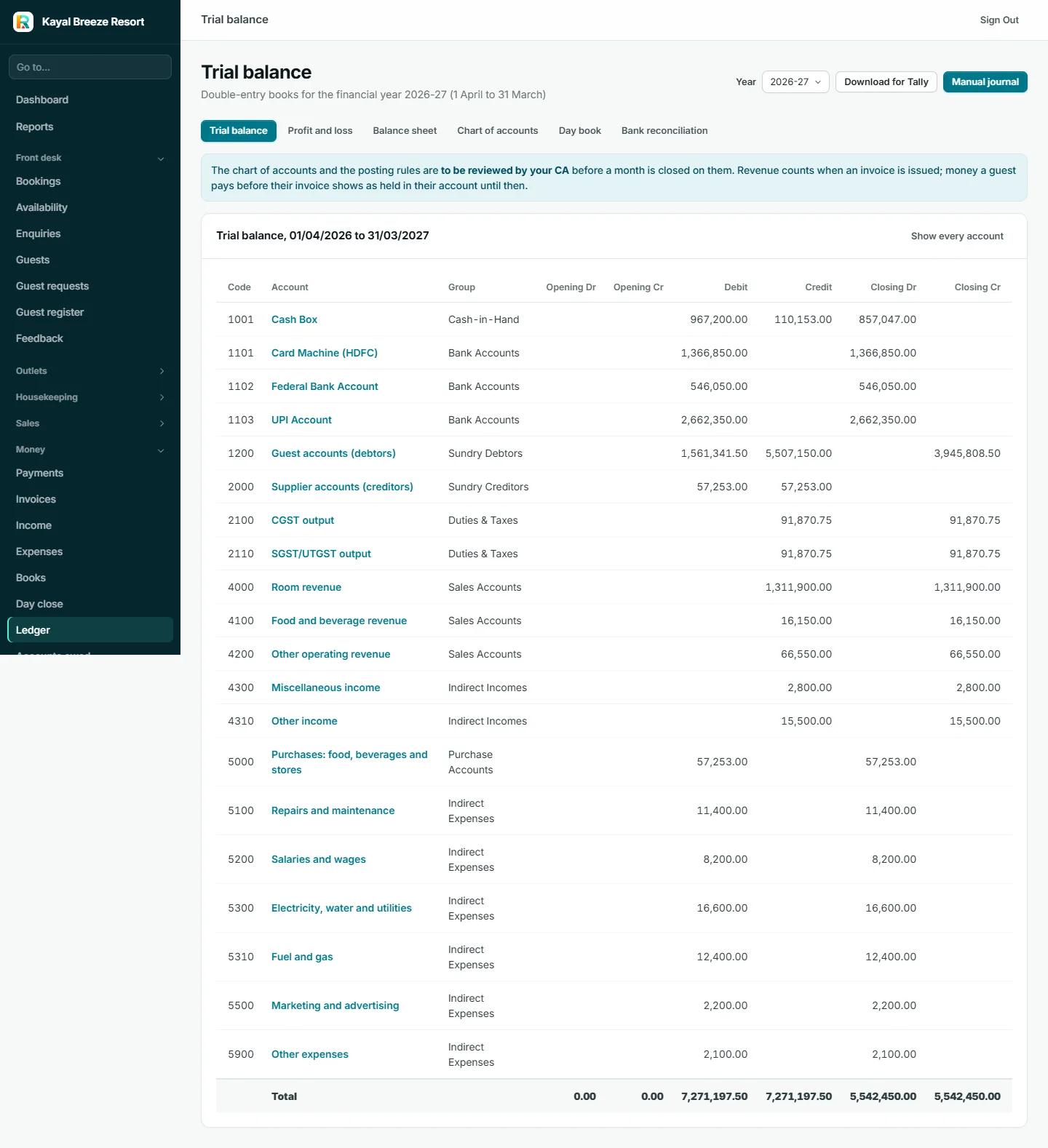
| Screen | Answers |
|---|---|
| Trial balance | Does everything add up? Each account's total for the year |
| Profit and loss | What did we earn, what did we spend, what is left? |
| Balance sheet | What does the business own and owe on a given day? |
| Chart of accounts | The list of accounts, each mapped to the group Tally uses |
| Day book | Every journal in date order |
| Bank reconciliation | Does the bank statement agree with the books? |

How entries get there
Nobody types them. Look at one in the day book:

When that invoice was issued, Resortiqo wrote: the guest owes ₹13,383.50; of that, ₹9,500 is room revenue, ₹2,070 is food revenue, and the rest is GST owed to the government. The same happens for receipts, refunds, expenses, purchase orders, supplier bills and, once payroll is switched on, salaries.
The accountant can add a Manual journal for anything the system cannot know, such as depreciation or a loan. Manual journals cannot be dated on a day that night audit has closed.
Bank reconciliation
Reconciling means checking the bank's statement against the books, line by line, to find anything missing or wrong.

- Download the statement from the bank's website as a CSV file.
- Import it into the matching bank account here. The columns are set once per bank.
- Resortiqo matches each line to a payment or receipt already in the books. The rest are matched by hand.
- Post what the bank added Bank charges and interest are entered straight from the statement line.
- Read the reconciliation statement which explains any difference between the bank's balance and the books'.
Sending the books to the CA
Download for Tally produces a file that Tally, the accounting software most Indian chartered accountants use, can import. The accounts are already named with Tally's own groups. The CA does the year-end filing in their software; Resortiqo is not a replacement for it.
What it connects to
- Invoices post revenue and GST
- Receipts and refunds
- Purchases and supplier bills
- Closed days are locked
- GST returns use the same figures
- Budgets compare against it
Not yet reviewed by a chartered accountant. The screen itself says so at the top of every page: the chart of accounts and the posting rules are to be reviewed by the resort's CA before a month is closed on them.
One bank line cannot yet be matched to several entries, which matters for card machines and UPI that pay out one lump sum for many guests. The value of stock on hand is not yet in the balance sheet.
The figures inside the accounts tables still show as 967,200.00, not in the Indian style used elsewhere (₹9,67,200).